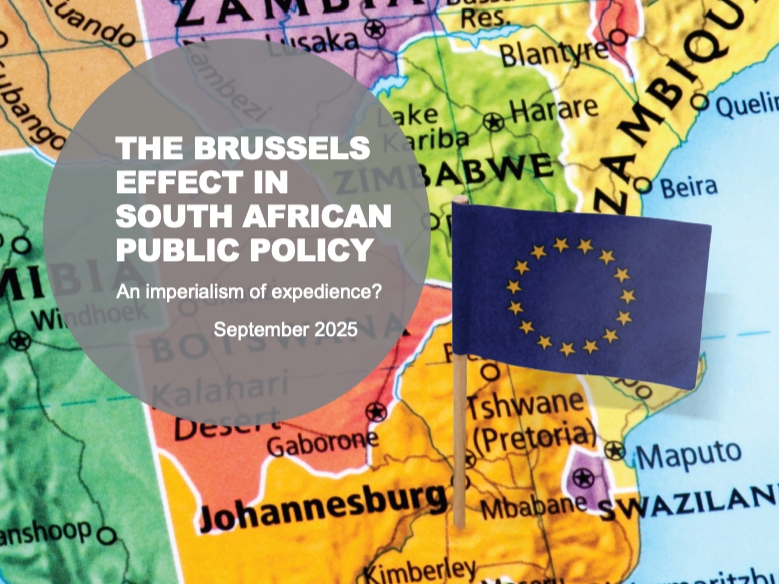
The ‘Brussels Effect’, a term coined by Anu Bradford (2020), describes the European Union’s ability to influence global regulatory standards due to its significant market size and political influence. This report, jointly prepared by the South African Free Market Foundation and the European Policy Information Center, examines how this phenomenon influences South African public policy, particularly in the areas of digital technology and artificial intelligence, and questions its suitability for the country’s economic context.
South Africa, grappling with low growth, high unemployment, and an inefficient public sector, has increasingly adopted EU-style regulations, such as the Protection of Personal Information Act (POPIA), which mirrors the EU’s General Data Protection Regulation (GDPR). Similarly, the Competition Commission’s recommendations draw inspiration from the EU’s Digital Markets Act (DMA) and Copyright Directive, while the National AI Policy Framework implicitly seeks eventual alignment with the EU’s Artificial Intelligence Act.
These policies, designed for wealthier economies, impose significant compliance costs on South African businesses, particularly startups and small and medium-sized enterprises (SMEs), stifling innovation and economic dynamism.
This uncritical adoption represents an imperialism of expedience, where South African policymakers opt for adopting pre-existing EU models, much to Brussels’ delight, rather than crafting solutions tailor-made to South Africa’s realities.
The GDPR’s stringent data rules, for instance, hinder AI development and data-driven research, while the DMA’s anti-gatekeeping measures and the Copyright Directive’s neighbouring rights burden digital platforms with costs that may reduce access to information. The EU’s AI Act, with its tiered risk framework, overregulates low-risk technologies, further disadvantaging smaller firms.
South Africa’s economic realities, characterised by growth rates increasingly rounding to zero, the highest formal unemployment rate in the world, and declining investment, contrast starkly with those of the EU. Adopting EU regulations without adaptation exacerbates these challenges, entrenching dependency and limiting competitiveness.
This report recommends strategic adaptation over passive compliance, urging South Africa to prioritise flexibility, innovation, and liberalisation. Specific proposals include exempting research from strict data consent rules, resisting censorship-adjacent policies, and adopting a light-touch approach to AI regulation to foster a competitive digital economy.
South Africa should draw inspiration from innovation-driven economies, such as Singapore or the United States, and tailor regulations to its developmental needs. By resisting the allure of EU regulatory models and embracing a deregulated, market-driven approach, South Africa can leverage technology to address its existential crises and build a resilient digital economy that empowers local stakeholders while remaining globally connected.
About the Authors
Martin van Staden is the Head of Policy at the Free Market Foundation in South Africa. A jurist and author, he is currently pursuing a doctorate in Law at the University of Pretoria, having acquired his Master of Laws with distinction at the same university. Martin is a Councillor at the Institute of Race Relations, the South African Policy Fellow at the Consumer Choice Center, and a Fellow at the Initiative for African Trade and Prosperity. Martin has contributed to the Economic Freedom of the World annual report, the annual International Property Rights Index, and the Cato Journal, among others.
Contact: martinvanstaden@fmfsa.org
Dr Morné Malan is a Senior Associate at the Free Market Foundation. He has a diverse educational background spanning philosophy, economics, law, ancient languages and cultures, as well as theology. Morné has many years of experience working as a policy analyst, communications professional, and strategic advisor in the non-governmental and public policy spheres. He previously worked as the Communications Manager at Sakeliga and held various positions at the Solidarity Movement, the Solidarity Research Institute, Akademia, and the Solidarity trade union.
Contact: malanmorne91@gmail.com
Zakhele Mthembu is a Policy Officer at the Free Market Foundation and holds a bachelor’s in Law and an LLB from the University of the Witwatersrand.
Contact: zakhelemthembu@fmfsa.org
Ayanda Sakhile Zulu is an Intern at the Free Market Foundation and holds a bachelor’s in Political Studies from the University of Pretoria.
Contact: intern@fmfsa.org
Christian N?sulea (PhD) teaches economics at the Faculty of History at the University of Bucharest and is an Associate Lecturer at the Faculty of Business Administration in Foreign Languages at the Bucharest University of Economic Studies. He is also the Executive Director of the Institute for Economic Studies – Europe and a Fellow of the Institut de Recherches Économiques et Fiscales. He holds a doctor’s degree in management with a thesis on complex adaptive systems. His research interests revolve around economics and technology. In addition to his academic work, he is also a tech entrepreneur, currently holding CEO or CTO positions in several tech businesses.
Contact: c.nasulea@ies-europe.org
Diana N?sulea (PhD) is Programmes Manager at the Institute for Economic Studies – Europe and a Fellow of the Institut de Recherches Économiques et Fiscales. She is also a teacher of diplomacy and international relations. Her PhD thesis in economics focused on consumer behaviour in the Romanian collaborative economy. Her research interests revolve around topics such as the sharing economy, regulation, trade, and new technologies.
Contact: d.nasulea@ies-europe.org
Introduction
Regulation is a necessary component of any modern economy, but its design and scope are crucial. Effective regulation should foster innovation, enable market participation, and remain adaptable to changing economic conditions. Yet, in fast-evolving sectors such as digital technology and artificial intelligence, overly restrictive or ill-suited regulatory models can impose substantial barriers, particularly on developing economies.
One of the most prominent forces shaping global regulatory trends today is the Brussels effect, which refers to the EU’s ability to extend its regulatory standards beyond its borders. Developed by Anu Bradford (2020), this term describes how the size and attractiveness of the EU market compel global firms, and increasingly, foreign governments, to conform to EU rules. Initially a by-product of commercial compliance, the Brussels effect has emerged into a form of regulatory power projection, subtly influencing the legal frameworks of non-EU jurisdictions.
South Africa is no exception. In recent years, its policymakers have embraced or mirrored EU-style regulations in several domains, including data protection, online platform governance, and artificial intelligence. While this alignment may be driven by a desire to remain interoperable with global norms or attract investment, it raises critical concerns: Are these regulations suitable for South Africa’s economic and institutional realities? Or are they imported solutions to problems the country does not share, with costs it cannot afford?
This report examines the impact of EU digital regulation on South African policy and law, both directly through legal instruments such as the Protection of Personal Information Act, and indirectly through agencies such as the Competition Commission and its recommendations inspired by the EU’s Digital Media Act. It also examines the National AI Policy Framework, which reflects an emerging tendency to accept EU-style regulatory templates as international best practice, even in the absence of a genuinely global standard.
The analysis rests on a central concern: context matters.
South Africa faces structurally low growth, widespread unemployment, and a public sector already burdened by inefficiency. Adopting regulatory frameworks developed in the context of high-income, technologically mature economies risks amplifying these problems rather than resolving them.
The General Data Protection Regulation, Digital Services Act, Digital Media Act, and Artificial Intelligence Act may reflect legitimate priorities in the EU, such as data protection, platform transparency, and algorithmic accountability. However, when applied to South Africa without significant adaptation, these regulations risk facilitating economic stagnation and policy dependency. Notably, even within the EU, member states are challenging these rules due to their risk of unintended consequences. For example, Bosch CEO Stefan Hartung recently warned that Europe is ‘regulating itself to death’,1 with excessive AI regulation reportedly delaying innovation and undermining competitiveness.
The Brussels effect, in this context, takes on a more critical dimension – one of imperialism by expedience. It becomes easier for policymakers to borrow from pre-existing regulatory models, particularly those with prestige and institutional weight, than to craft homegrown solutions that align with domestic realities. But this shortcut has long-term consequences. It undermines innovation, discourages experimentation, and imposes compliance costs that disproportionately affect startups, SMEs, and underfunded public institutions.
The following sections examine how the Brussels effect manifests across various South African policy domains, particularly in data protection, digital markets, and AI governance. They evaluate the economic and competitive costs, particularly for small firms, and highlight how EU rules, exported globally, can undermine local dynamism. This report offers targeted recommendations to prioritise flexibility, strategic adaptation, and innovation-driven growth, urging South Africa to resist the allure of imported regulation.
By charting a path customised to its own context, South Africa can leverage technology to address unemployment, spur investment, and foster a competitive and open digital economy.
As the EU increasingly positions itself as a global standard-setter, countries such as South Africa are engaging critically with this influence. Strategic adaptation, not passive compliance, must be the goal. Regulatory models must empower change, not entrench hierarchy. If innovation is to be the driver of development in the twenty-first century, then regulation must become its ally, not its adversary.
The Brussels Effect
The EU is increasingly shaping global regulatory standards, particularly in the digital sphere. This phenomenon, known as the Brussels effect, refers to the way EU rules often become global benchmarks, owing to the size and attractiveness of its internal market. As Giuseppe Colangelo observes, one of the objectives pursued by EU institutions is ‘to assert European leadership as a regulatory model for other countries’ (Stagnaro and N?sulea 2025: 43), highlighting how the Union’s internal regulatory ambitions can exert their influence well beyond its borders.
When the EU introduces new rules, companies take notice first. These rules may relate to data protection, environmental policy, competition law, or consumer safety. Firms that desire access to the EU market would then tend to adopt these standards, despite their local regulators perhaps imposing more flexible requirements. The companies standardise ‘to the bottom’ of the EU, then, to avoid the cost of complying with multiple regimes.2
As a result, EU rules have a significant influence on business practices worldwide. The consequence of this is that some governments seek to align their regulations with European standards, incorporating them into their legal and regulatory frameworks. For instance, in May 2022, André de Ruyter, then chief executive officer of South Africa’s state-owned electricity company, Eskom, cautioned that anti–fossil-fuel decisions made abroad effectively prevent South Africa from exploiting its abundant coal resources to alleviate its electricity crisis. De Ruyter said this amidst South Africa’s worst bout of rolling blackouts, which reached its peak in 2023, crushing the South African economy.3 Among other things, De Ruyter was alluding to the EU’s Carbon Border Adjustment Mechanism (CBAM), which, starting from 2026, will levy a tax on imports of certain goods (such as steel and cement) entering the EU based on the carbon emissions produced during their manufacture. De Ruyter continued:
“We can rail against this injustice. You know: ‘The rich world built their economies on coal, and we’re not allowed to do the same.’ But the bottom line is, having a grudge against reality doesn’t help – you need to take account of the facts as they are.”4
We are, however, of the view that indirect regulatory overreach and impositions by advanced economies – which, in this event, is fairly labelled eco-imperialism – can and should be called out. Furthermore, it can and should be reversed, rather than reluctantly adopted under international pressure as (in De Ruyter’s words) a ‘unique opportunity’ to, ultimately, do things more expensively and inefficiently. This imposes costs that developing economies such as South Africa can ill afford.
What we observe here is a very direct political manifestation of the usually indirect commercial Brussels effect: a non-EU state actively making existential policy decisions (mistakes, in this case) that are largely premised on how Europeans will react. This is, of course, the aim of measures such as the CBAM, and in that sense, it functions effectively. It is, nonetheless, still a significant hindrance to the growth and prosperity of developing societies, such as South Africa.
In this report, we examine the legal and policy implications of the Brussels effect on South Africa’s technological development. It should, thus, be noted at this early juncture that the Brussels effect has generally concerned commercial (not policy) decisions taken by private non-EU firms to align themselves with the EU’s regulatory framework. A similar phenomenon, known as the ‘California effect’ (Princen 1999: 1), refers to policy (not commercial) decisions made by non-Californian regulators to align their jurisdictions with California’s regulatory framework. This report is more concerned with the latter than the former; viz., how policy decisions in Brussels affect South African policymakers, rather than South African firms.
‘Bosch CEO warns Europe against regulating “itself to death” on AI’, Reuters, 25 June 2025 (https://www.reuters.com/technology/bosch-ceo-warns-europe-againstregulating-itself-death-ai-2025-06-25/). ↩︎
The Brussels effect has been described as a ‘race to the top’, with deregulation often characterised as a ‘race to the bottom’. In our view such a conceptualisation is not borne from the evidence. As is seen in the research conducted by the Fraser Institute, a deregulatory dispensation has better human development outcomes as opposed to the worse outcomes found in frameworks of overregulation. See ‘Economic Freedom of the World’, Fraser Institute, n.d. (https://www.fraserinstitute.org/categories/economic-freedom-world). ↩︎
‘Load shedding in 2023 worse than the last eight years combined’, Moneyweb, 8 September 2023 (https://www.moneyweb.co.za/news/south-africa/load-shedding-in2023-worse-than-the-last-eight-years-combined/). ↩︎
‘André de Ruyter on fixing Eskom’, YouTube, 29 May 2022 (https://www.youtube.com/watch?v=3otQ3yHckco). ↩︎

Summary
About the Authors
Martin van Staden is the Head of Policy at the Free Market Foundation in South Africa. A jurist and author, he is currently pursuing a doctorate in Law at the University of Pretoria, having acquired his Master of Laws with distinction at the same university. Martin is a Councillor at the Institute of Race Relations, the South African Policy Fellow at the Consumer Choice Center, and a Fellow at the Initiative for African Trade and Prosperity. Martin has contributed to the Economic Freedom of the World annual report, the annual International Property Rights Index, and the Cato Journal, among others.
Contact: martinvanstaden@fmfsa.org
Dr Morné Malan is a Senior Associate at the Free Market Foundation. He has a diverse educational background spanning philosophy, economics, law, ancient languages and cultures, as well as theology. Morné has many years of experience working as a policy analyst, communications professional, and strategic advisor in the non-governmental and public policy spheres. He previously worked as the Communications Manager at Sakeliga and held various positions at the Solidarity Movement, the Solidarity Research Institute, Akademia, and the Solidarity trade union.
Contact: malanmorne91@gmail.com
Zakhele Mthembu is a Policy Officer at the Free Market Foundation and holds a bachelor’s in Law and an LLB from the University of the Witwatersrand.
Contact: zakhelemthembu@fmfsa.org
Ayanda Sakhile Zulu is an Intern at the Free Market Foundation and holds a bachelor’s in Political Studies from the University of Pretoria.
Contact: intern@fmfsa.org
Christian N?sulea (PhD) teaches economics at the Faculty of History at the University of Bucharest and is an Associate Lecturer at the Faculty of Business Administration in Foreign Languages at the Bucharest University of Economic Studies. He is also the Executive Director of the Institute for Economic Studies
– Europe and a Fellow of the Institut de Recherches Économiques et Fiscales. He holds a doctor’s degree in management with a thesis on complex adaptive systems. His research interests revolve around economics and technology. In addition to his academic work, he is also a tech entrepreneur, currently holding CEO or CTO positions in several tech businesses.
Contact: c.nasulea@ies-europe.org
Diana N?sulea (PhD) is Programmes Manager at the Institute for Economic
Studies – Europe and a Fellow of the Institut de Recherches Économiques
et Fiscales. She is also a teacher of diplomacy and international relations.
Her PhD thesis in economics focused on consumer behaviour in the Romanian
collaborative economy. Her research interests revolve around topics such as
the sharing economy, regulation, trade, and new technologies.
Contact: d.nasulea@ies-europe.org
Introduction
Regulation is a necessary component of any modern economy, but its design and scope are crucial. Effective regulation should foster innovation, enable market participation, and remain adaptable to changing economic conditions. Yet, in fast-evolving sectors such as digital technology and artificial intelligence, overly restrictive or ill-suited regulatory models can impose substantial barriers, particularly on developing economies.
One of the most prominent forces shaping global regulatory trends today is the Brussels effect, which refers to the EU’s ability to extend its regulatory standards beyond its borders. Developed by Anu Bradford (2020), this term describes how the size and attractiveness of the EU market compel global firms, and increasingly, foreign governments, to conform to EU rules. Initially a by-product of commercial compliance, the Brussels effect has emerged into a form of regulatory power projection, subtly influencing the legal frameworks of non-EU jurisdictions.
South Africa is no exception. In recent years, its policymakers have embraced or mirrored EU-style regulations in several domains, including data protection, online platform governance, and artificial intelligence. While this alignment may be driven by a desire to remain interoperable with global norms or attract investment, it raises critical concerns: Are these regulations suitable for South Africa’s economic and institutional realities? Or are they imported solutions to problems the country does not share, with costs it cannot afford?
This report examines the impact of EU digital regulation on South African policy and law, both directly through legal instruments such as the Protection of Personal Information Act, and indirectly through agencies such as the Competition Commission and its recommendations inspired by the EU’s Digital Media Act. It also examines the National AI Policy Framework, which reflects an emerging tendency to accept EU-style regulatory templates as international best practice, even in the absence of a genuinely global standard.
The analysis rests on a central concern: context matters.
South Africa faces structurally low growth, widespread unemployment, and a public sector already burdened by inefficiency. Adopting regulatory frameworks developed in the context of high-income, technologically mature economies risks amplifying these problems rather than resolving them.
The General Data Protection Regulation, Digital Services Act, Digital Media Act, and Artificial Intelligence Act may reflect legitimate priorities in the EU, such as data protection, platform transparency, and algorithmic accountability. However, when applied to South Africa without significant adaptation, these regulations risk facilitating economic stagnation and policy dependency. Notably, even within the EU, member states are challenging these rules due to their risk of unintended consequences. For example, Bosch CEO Stefan Hartung recently warned that Europe is ‘regulating itself to death’,1 with excessive AI regulation reportedly delaying innovation and undermining competitiveness.
The Brussels effect, in this context, takes on a more critical dimension – one of imperialism by expedience. It becomes easier for policymakers to borrow from pre-existing regulatory models, particularly those with prestige and institutional weight, than to craft homegrown solutions that align with domestic realities. But this shortcut has long-term consequences. It undermines innovation, discourages experimentation, and imposes compliance costs that disproportionately affect startups, SMEs, and underfunded public institutions.
The following sections examine how the Brussels effect manifests across various South African policy domains, particularly in data protection, digital markets, and AI governance. They evaluate the economic and competitive costs, particularly for small firms, and highlight how EU rules, exported globally, can undermine local dynamism. This report offers targeted recommendations to prioritise flexibility, strategic adaptation, and innovation-driven growth, urging South Africa to resist the allure of imported regulation.
By charting a path customised to its own context, South Africa can leverage technology to address unemployment, spur investment, and foster a competitive and open digital economy.
As the EU increasingly positions itself as a global standard-setter, countries such as South Africa are engaging critically with this influence. Strategic adaptation, not passive compliance, must be the goal. Regulatory models must empower change, not entrench hierarchy. If innovation is to be the driver of development in the twenty-first century, then regulation must become its ally, not its adversary.
The Brussels Effect
The EU is increasingly shaping global regulatory standards, particularly in the digital sphere. This phenomenon, known as the Brussels effect, refers to the way EU rules often become global benchmarks, owing to the size and attractiveness of its internal market. As Giuseppe Colangelo observes, one of the objectives pursued by EU institutions is ‘to assert European leadership as a regulatory model for other countries’ (Stagnaro and N?sulea 2025: 43), highlighting how the Union’s internal regulatory ambitions can exert their influence well beyond its borders.
When the EU introduces new rules, companies take notice first. These rules may relate to data protection, environmental policy, competition law, or consumer safety. Firms that desire access to the EU market would then tend to adopt these standards, despite their local regulators perhaps imposing more flexible requirements. The companies standardise ‘to the bottom’ of the EU, then, to avoid the cost of complying with multiple regimes.2
As a result, EU rules have a significant influence on business practices worldwide. The consequence of this is that some governments seek to align their regulations with European standards, incorporating them into their legal and regulatory frameworks. For instance, in May 2022, André de Ruyter, then chief executive officer of South Africa’s state-owned electricity company, Eskom, cautioned that anti–fossil-fuel decisions made abroad effectively prevent South Africa from exploiting its abundant coal resources to alleviate its electricity crisis. De Ruyter said this amidst South Africa’s worst bout of rolling blackouts, which reached its peak in 2023, crushing the South African economy.3 Among other things, De Ruyter was alluding to the EU’s Carbon Border Adjustment Mechanism (CBAM), which, starting from 2026, will levy a tax on imports of certain goods (such as steel and cement) entering the EU based on the carbon emissions produced during their manufacture. De Ruyter continued:
We are, however, of the view that indirect regulatory overreach and impositions by advanced economies – which, in this event, is fairly labelled eco-imperialism – can and should be called out. Furthermore, it can and should be reversed, rather than reluctantly adopted under international pressure as (in De Ruyter’s words) a ‘unique opportunity’ to, ultimately, do things more expensively and inefficiently. This imposes costs that developing economies such as South Africa can ill afford.
What we observe here is a very direct political manifestation of the usually indirect commercial Brussels effect: a non-EU state actively making existential policy decisions (mistakes, in this case) that are largely premised on how Europeans will react. This is, of course, the aim of measures such as the CBAM, and in that sense, it functions effectively. It is, nonetheless, still a significant hindrance to the growth and prosperity of developing societies, such as South Africa.
In this report, we examine the legal and policy implications of the Brussels
effect on South Africa’s technological development. It should, thus, be noted at this early juncture that the Brussels effect has generally concerned commercial (not policy) decisions taken by private non-EU firms to align themselves with the EU’s regulatory framework. A similar phenomenon, known as the ‘California effect’ (Princen 1999: 1), refers to policy (not commercial) decisions made by non-Californian regulators to align their jurisdictions with California’s regulatory framework. This report is more concerned with the latter than the former; viz., how policy decisions in Brussels affect South African policymakers, rather than South African firms.
Full Paper (PDF)
Footnotes
25 June 2025 (https://www.reuters.com/technology/bosch-ceo-warns-europe-againstregulating-itself-death-ai-2025-06-25/). ↩︎